|
Capital Provider Showcase
Dialogue with Leena Dandekar, Founder and Chairperson, Raintree Family Office and Raintree Foundation
|
|
1
How does Raintree think about effectiveness in philanthropy when change requires long time horizons, ecosystem coordination, and institutional shifts, rather than immediately measurable outcomes, and how does this influence funding duration or partnership design? What considerations have shaped your approach to engaging with more systemic forms of philanthropy?
|
At Raintree, we begin with the acceptance that meaningful change, especially in areas like climate resilience, livelihoods, and water security, is inherently long-term and non-linear. Effectiveness, for us, cannot be reduced to short-term outputs alone. Instead, we look for directional progress: are incentives shifting, are local institutions becoming stronger, are communities better able to steward their landscapes over time?
This perspective can shape both funding duration and partnership design. We commit to long-term horizons upfront. Our philanthropic capital is structured to provide predictability over 10-15 years, allowing for planning, experimentation, failure, and adaptation.
We also prioritise ecosystem coordination over isolated interventions. Many of the challenges we work on require alignment across communities, civil society, markets, and the state. Our role is often to support patient convening, field-building, and institutional capacity—areas that are difficult to measure immediately but essential for durable change.
Ultimately, we see philanthropic effectiveness not as “how fast can we show results,” but as “are we creating the conditions for outcomes to endure long after our presence reduces?”
|
2
How have insights from earlier philanthropic engagements influenced or reshaped Raintree’s approach to capital allocation, impact assessment, or collaborative partnerships?
|
Our early philanthropic engagements taught us humility. We learned quickly that capital alone does not create impact and that context, trust, and time matter just as much. Many well-intentioned interventions fail not because the idea is flawed, but because the ecosystems around them are not ready or aligned.
These learnings reshaped how we allocate capital across the spectrum. We became more deliberate about matching the right form of capital to the right stage of a solution. Where markets are immature or incentives misaligned, we lean into grants and long-term philanthropic support. Where models are emerging but fragile, we support capacity-building rather than pushing for premature scale.
As far as partnerships are concerned, we prioritise deep, collaborative relationships over transactional funding. We work closely with partners to co-design goals, adapt strategies, and course-correct as realities on the ground change. This requires patience and mutual trust, but it leads to stronger outcomes.
Importantly, these experiences have reinforced our belief that family office capital, because it is flexible and unconstrained, has a responsibility to absorb uncertainty where other types of capital cannot.
|
3
Where do you see the most significant gaps in India’s impact capital spectrum, particularly those that are structural or pre-commercial in nature and therefore require philanthropic capital rather than traditional investment?
|
India’s impact ecosystem has grown significantly, particularly in sectors where commercial viability and scale are clearer, such as microfinance, renewable energy, and education. However, there remain substantial gaps in areas that are structural, pre-commercial, or systems-oriented.
Sectors like climate adaptation, water and sanitation, regenerative agriculture, biodiversity conservation, and deep climate-tech often struggle to attract traditional investment. The time horizons are long, returns are uncertain or indirect, and success depends on coordination across multiple stakeholders rather than a single scalable enterprise.
These are precisely the spaces where philanthropic capital is most critical. It can underwrite early experimentation, support enabling infrastructure, and fund public goods that markets alone will not. While some blended finance and catalytic capital initiatives are emerging, they remain limited in scale.
We believe philanthropy must play a more intentional role in absorbing early risk, building field-level knowledge, and supporting institutions that create the conditions for future commercial or public investment. From our perspective, this early-stage work is essential to maximising the impact that each unit of capital can ultimately create, which is also the impact investment strategy at the Raintree Family Office. Without this foundational layer, many promising solutions will never reach the point where other forms of capital can engage meaningfully.
|
4
Looking ahead, do you see philanthropy in India becoming more comfortable with hybrid models that blend grants, guarantees, and investments—or remaining distinct from financial capital?
|
Yes, we do see philanthropy in India gradually becoming more open to hybrid and blended models that combine grants, guarantees, and investments. This evolution is both necessary and inevitable, given the complexity of the challenges we face.
There is growing recognition that rigid boundaries between philanthropic and financial capital can limit effectiveness. Thoughtful hybrid structures can help de-risk innovation, bring in additional capital, and extend the reach of philanthropic funds.
That said, success will depend on design discipline. Not every problem requires a blended solution, and not every hybrid instrument is appropriate. Philanthropy must remain clear about its primary role: enabling outcomes that markets and the state cannot deliver on their own.
At Raintree, we see hybrid models as part of a broader toolkit; not a replacement for grants, but a complement where conditions allow. As more pilots demonstrate credibility and learning accumulates, we expect comfort and participation to increase.
|
5
As India’s impact ecosystem matures, what role do you believe foundations like Raintree are best positioned to play, one that complements rather than overlaps with the roles of the state and impact investors?
|
As the ecosystem matures, we believe foundations like Raintree are best positioned to play a catalytic role. Our strength lies in patience, flexibility, and the ability to take a systems view.
We see our role as supporting what others cannot easily do: funding long-term processes, backing unglamorous but essential work, and holding space for experimentation and learning. This includes strengthening local institutions, supporting field-building, and enabling collaboration across sectors.
We also believe foundations can help shape norms around time horizons, partnership models, and what “success” looks like in complex systems. By demonstrating that capital can be deployed with humility and restraint, we hope to contribute to a more thoughtful impact culture.
Ultimately, our goal is not to be central actors, but to help create conditions where solutions can thrive independently, long after our direct involvement reduces.
|
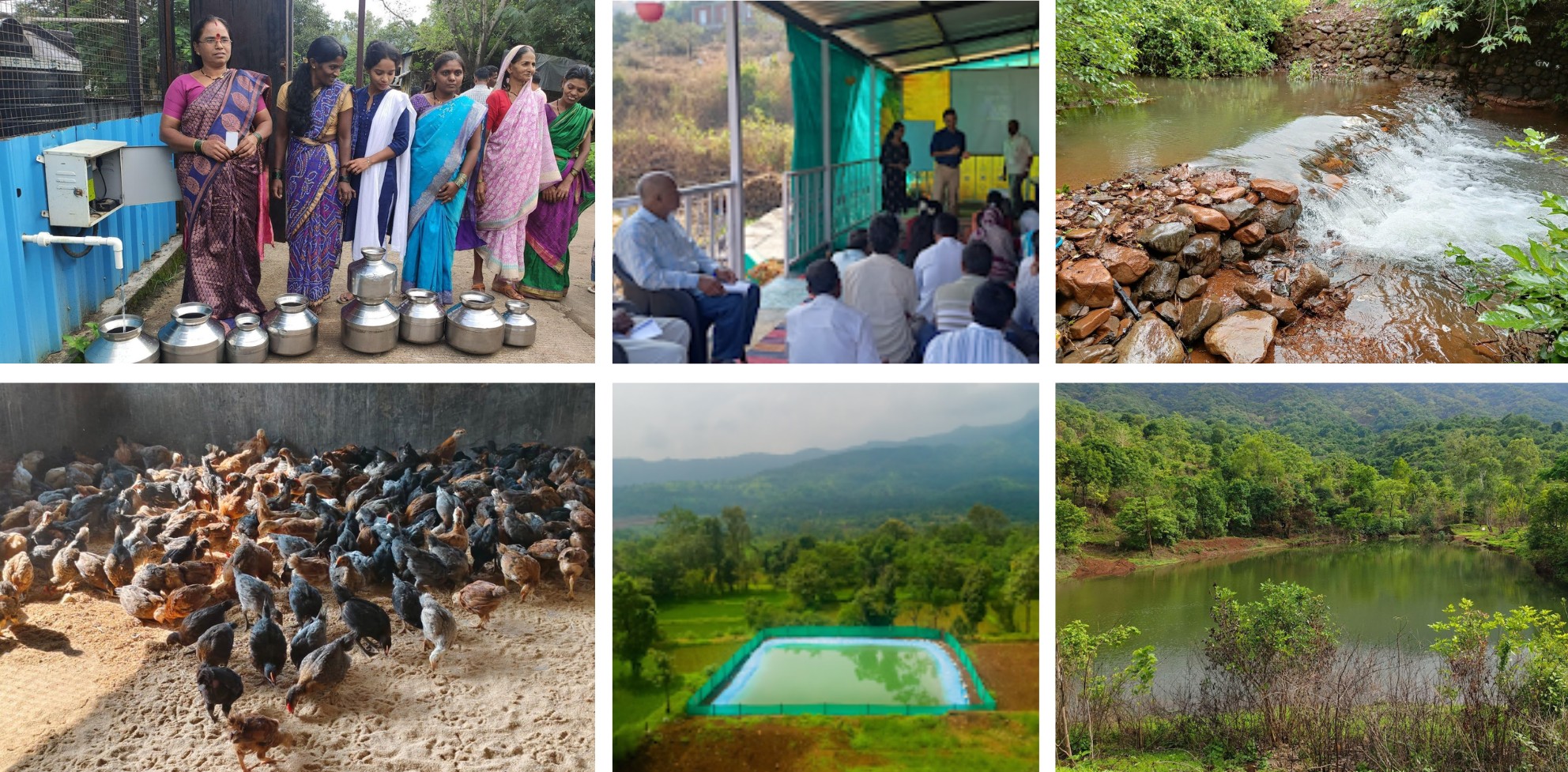
These images reflect Raintree Foundation’s integrated approach in the Northern Western Ghats: solar-powered water ATMs providing clean drinking water, rainwater-harvesting farm ponds supporting agriculture and horticulture, village biodiversity management committees strengthened through training and capacity building, livelihood initiatives like backyard poultry, and soil- and water-conservation structures, including percolation tanks, that have helped recharge groundwater and revive wells, showing how community-led solutions build long-term resilience.
|
|
|
Leena Dandekar, Founder and Chairperson, Raintree Family Office and Raintree Foundation
Leena Dandekar, Founder and Chairperson of Raintree Family Office and Raintree Foundation, has been among the pioneers of impact investing in India. A former Director of the Camlin Group, she has dedicated her capital, networks, and leadership to advancing climate action and responsible consumption. Through Raintree, she envisions building climate-smart, inclusive ecosystems that restore balance between people and nature—one piece of Earth at a time.
About Raintree Family Office
The Raintree Family Office was established by Leena Dandekar, Abha Dandekar and Vivek Dandekar with the objective of investing the family-owned funds towards a portfolio promoting innovation in climate solutions, sustainability and responsible consumption.
The family office manages two distinct pools of capital: a proprietary, for-profit pool that invests in the capital markets, with a significant portion allocated to building an environmentally and socially conscious portfolio of alternative assets; and a not-for-profit pool that supports the philanthropic initiatives of the Raintree Foundation.
For more information: https://theraintree.co.in/
|
|
About Impact Investors Council:
Impact Investors Council, India (IIC) is a member-based national industry body formed with an
objective to build and strengthen the impact investing eco-system in India. To know more about our work visit https://iiic.in or reach out to secretariat@iiic.in
|
Disclaimer: Data and Information in this newsletter is made available in good faith with the exclusive intention of helping market and ecosystem players, policymakers and the public build a greater
understanding of the Indian impact investing market. The data is collated from sources believed to be reliable and accurate at the time of publication. Readers are urged to exercise independent judgment and diligence in the
usage of this information for any investment decisions
Some of the information provided in this newsletter is supplied by third parties. It is important that all users understand that third party information is not an endorsement of any nature and has been put together with the
sole purpose of benefiting stakeholders.
|
| Unsubscribe |
|
|
|
.jpg)