|
Capital Provider Showcase
Dialogue with Ankur Bansal, Managing Director, BlackSoil
|
|

1
BlackSoil operates at the intersection of venture ecosystems and private credit. How do you decide which segments of the growth market are best served by structured debt versus equity or traditional bank capital, and how has that positioning evolved as India’s startup and MSME ecosystem has matured?
|
The businesses we work with occupy a space that traditional banks typically find difficult to underwrite, not because these companies aren't creditworthy but because their risk profile does not fit conventional frameworks. Evolving business models, early-stage profitability curves, and asset-light balance sheets make them structurally misaligned with bank lending criteria. That is precisely where BlackSoil has built its edge.
Our instrument suite reflects this nuance; we deploy term loans, purchase and sales invoice discounting, subordinated debt, and venture debt, calibrating each to the specific needs and risk contours of the company in front of us. What has not changed is our core philosophy. We believe growth-focused companies deserve capital that is right in structure, right in size, and right in timing. Off-the-shelf financing rarely delivers all three simultaneously.
As India's startup and MSME ecosystem has matured, we have seen the financing landscape evolve from a near-binary choice between equity and bank debt toward a much more sophisticated middle ground. Structured credit has become a legitimate and often preferred option for founders who want growth capital without the dilution of equity and for businesses that are simply too dynamic or early for banks to accommodate. That evolution validates what BlackSoil set out to do nearly a decade ago.
|
2
Following the recent merger with Caspian Debt, how has the addition led to differences in underwriting approach, risk tolerance, or the stage and profile of enterprises you now finance?
|
When two institutions with genuinely similar credit cultures combine, the outcome is multiplication rather than addition, and that is how I would characterise our merger with Caspian Debt, now rebranded as Udhyam Debt – a division of BlackSoil.
Both BlackSoil and Caspian Debt were known for conservative underwriting discipline. There was never a clash of credit philosophy. The meaningful difference was one of market segments. BlackSoil has historically partnered with growth-stage companies scaling across sectors. Caspian Debt, on the other hand, focused on early-stage MSMEs, enterprises that demonstrate predictable cash flows, sound governance, and institutional operating standards but are still too nascent for mainstream capital.
As a combined entity, we have deliberately preserved that segmentation. Udhyam Debt continues its mission of MSME financing with full integrity, prioritising lending in climate, education, agriculture, and the rural economy. We are not diluting that mandate in the pursuit of scale. The merger has unlocked the ability to serve a company at every crucial stage of its financing journey, from early-stage MSME to growth-scale enterprise.
|
3
How do BlackSoil’s risk-shared/structured credit combine loan design and risk-sharing (guarantees, subordinated or first-loss capital) to improve enterprise durability, and have they allowed you to finance businesses that would otherwise fall outside your conventional venture debt mandate?
|
Across our decade-plus of investing, one pattern has held consistently – the businesses with the greatest potential for social and environmental impact are rarely the easiest to finance. "Solving a tough problem" and "being early stage" are two descriptors that routinely translate to "high risk" on a credit committee's worksheet, and that is true even for impact-focused lenders like us. Navigating that tension requires more than good intentions; it requires structural solutions and the right partners.
Two partnerships have been particularly transformative in this regard. Our knowledge and risk-sharing arrangement with the Rabo Foundation opened the door to deep engagement with food and agriculture, a sector where their expertise is unmatched. Working together, we have financed themes like regenerative agriculture, climate-smart agriculture, and AgriTech that would have been difficult to underwrite without that institutional backing and sectoral intelligence.
Equally significant has been our enrollment in the DCA Portfolio Guarantee Program under the US Development Finance Corporation (DFC). The DCA was designed with a specific purpose, and that was to encourage better product design, longer tenors, and financing for enterprises that might not otherwise qualify on pure risk grounds. With that backstop, we have funded high-impact companies across clean technology and Water, Sanitation and Hygiene, businesses that sit squarely in the public interest but have struggled to access institutional debt.
Beyond these, partnerships with IPE Global in healthcare, MSDF in nano entrepreneurship, and Villgro in early-stage clean tech and agri ventures have unlocked financing frontiers that institutional capital rarely reaches. These relationships are not peripheral to our strategy; they are central to it.
|
4
When risk participation or institutional support is introduced, how does your definition of “repayability” change during underwriting? Do you move from collateral and current cash flows toward projected unit economics or ecosystem position, and what safeguards prevent this from becoming equity-like risk?
|
The most important safeguard is one that precedes any finance conversation - we do not deploy capital in sectors or supply chains we do not deeply understand.
Blended finance structures are like the cherry on top of a well-made cake. They can make a good deal better; they cannot make a poor deal fundable. Before any guarantee or first-loss capital is factored in, we need to be satisfied with the business model, the cash flow dynamics, the governance, and the exit visibility of the investee.
Our due diligence process is built around identifying material gaps and working with companies to address them. We structure genuinely customised solutions, matching instruments to need, and calibrating risk-sharing so that incentives are properly aligned for both lender and borrower. We also lean heavily on our network of trusted domain experts and institutional partners who bring the specialised knowledge that informs our credit judgement.
The discipline that ultimately separates structured debt from equity risk is not the instrument; it is the rigour of ongoing monitoring. We track our portfolio monthly, specifically to surface early warning indicators before they materialise into actual stress. Our portfolio quality over the past decade is the most honest measure of whether that process works.
|
5
Looking ahead, how do you see structured credit solutions evolving in India’s alternative credit market? Do they mainly expand access to credit for underserved segments or help businesses transition toward fully commercial financing? Within that evolution, how do you see BlackSoil’s role in the ecosystem?
|
Structured credit in India is at an inflection point. For years, it was a niche; understood by a small community of practitioners and largely invisible to mainstream capital markets. That is changing rapidly, driven by the maturing of the startup ecosystem, the formalisation of MSME credit infrastructure, and growing investor appetite for yield with impact.
The question is often framed as a binary. Does structured credit expand access for underserved segments, or does it bridge businesses toward fully commercial financing? My view is that it does both, and that the most exciting opportunity lies in building the connective tissue between those two outcomes.
The BlackSoil-Caspian Debt merger has given us a uniquely broad vantage point. Through our MSME-focused division Udhyam Debt, we lend to early-stage MSMEs in underserved markets, businesses that are impact-rich but credit-thin. We also partner with growth-stage and new economy companies that co-exist alongside banks and commercial financiers. Additionally, through our supply chain finance platform SaralSCF, we extend working capital to the vendors and distributors embedded within those value chains, ensuring that liquidity flows not just to the anchor enterprise but to the smaller businesses that sustain it. Together, we can accompany an enterprise across the arc of its financial life, from early institutional credit to sophisticated structured instruments.
That continuity of partnership is what I believe India's alternative credit market needs most. Not just more capital, but smarter, more patient capital that grows with the businesses it backs. That is the role BlackSoil is committed to playing.
|
|
|
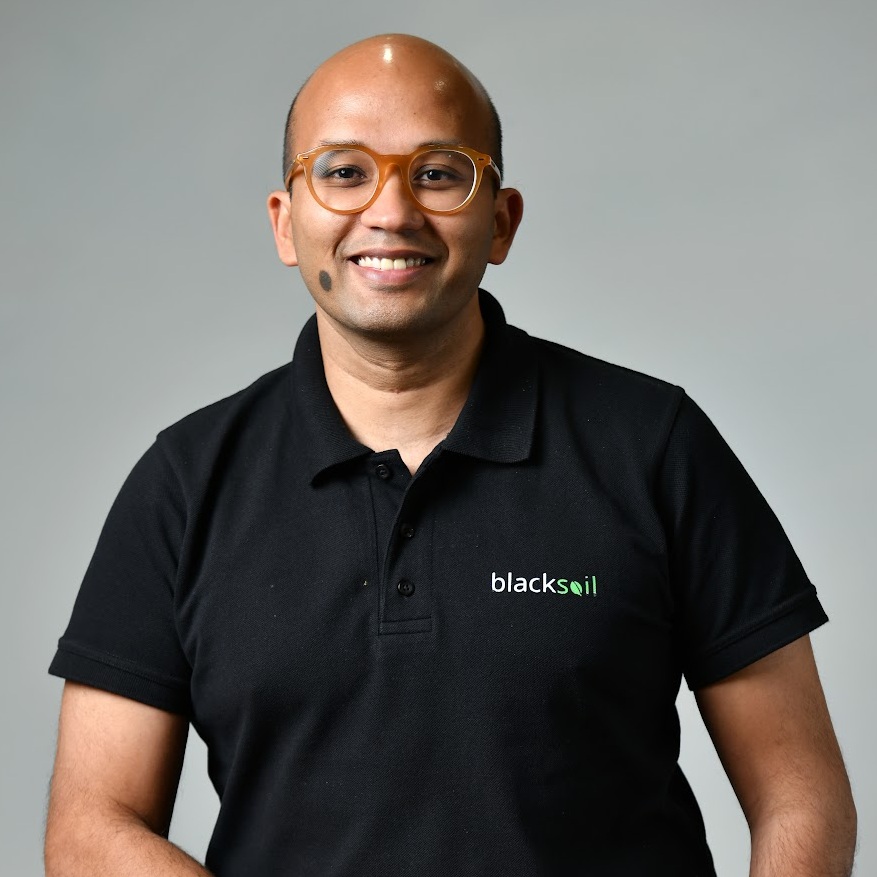
Ankur Bansal, Managing Director, BlackSoil
Ankur is the driving force behind BlackSoil Group’s emergence as a leading alternative credit platform in India. He transformed BlackSoil from a financial consulting firm into an alternative credit platform comprising an NBFC and six credit funds. He leads BlackSoil’s growth strategy, including its expansion into Southeast Asia and the strategic merger with impact-focused lender Caspian Debt. Ankur also serves as an independent director at Prince Pipes and Fittings and K12 Techno Service.
About Blacksoil
Established in 2016, BlackSoil is a leading alternative credit platform comprising an RBI-registered systemically important NBFC and a SEBI-registered AIF. With $250 million in AUM and an A- (Stable) / A2+ rating from ICRA, it has built a strong track record serving MSMEs, emerging corporates, and financial institutions across India and Southeast Asia. It provides alternative credit and working capital to fast-growing and underserved new-economy businesses. Its portfolio includes eleven unicorns and fourteen publicly listed companies.
BlackSoil integrates ESG principles across its investment lifecycle and is backed by global DFIs, institutional investors, and leading Indian family offices.
For more information: https://blacksoil.co.in/
|
|
About Impact Investors Council:
Impact Investors Council, India (IIC) is a member-based national industry body formed with an
objective to build and strengthen the impact investing eco-system in India. To know more about our work visit https://iiic.in or reach out to secretariat@iiic.in
|
Disclaimer: Data and Information in this newsletter is made available in good faith with the exclusive intention of helping market and ecosystem players, policymakers and the public build a greater
understanding of the Indian impact investing market. The data is collated from sources believed to be reliable and accurate at the time of publication. Readers are urged to exercise independent judgment and diligence in the
usage of this information for any investment decisions
Some of the information provided in this newsletter is supplied by third parties. It is important that all users understand that third party information is not an endorsement of any nature and has been put together with the
sole purpose of benefiting stakeholders.
|
| Unsubscribe |
|
|
|