Q1: An introduction to Alt Carbon’s positioning within the carbon removal landscape would be helpful, particularly in understanding how Enhanced Rock Weathering (ERW) fits into the broader mission. What considerations made ERW an especially viable pathway compared to other approaches?
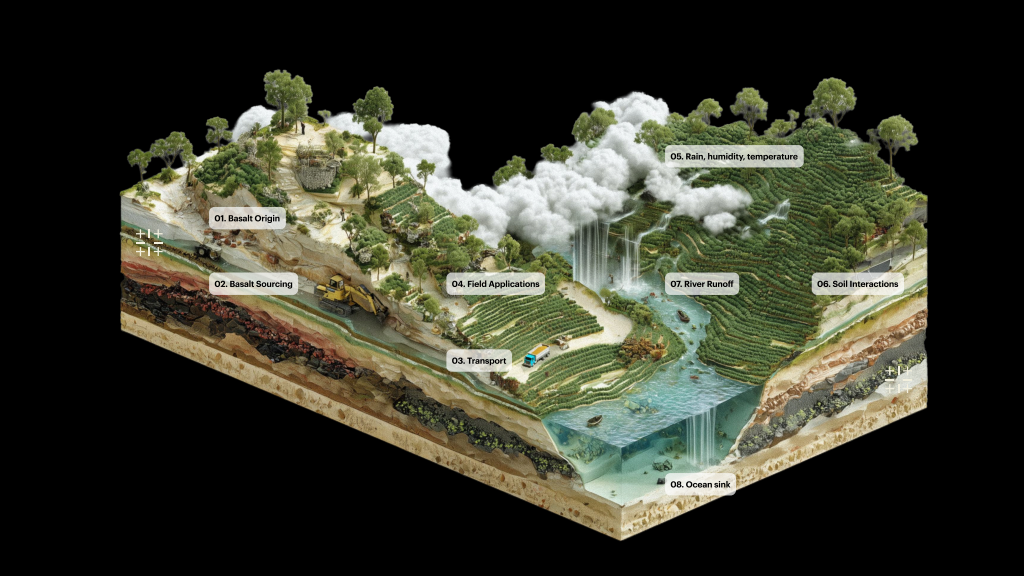
Our Darjeeling Revival Project (DRP) leverages Enhanced Rock Weathering (ERW) to capture and durably store atmospheric carbon. ERW is a nature-based, science-rooted, durable carbon removal method that accelerates the natural chemical weathering of rocks to remove CO₂ from the atmosphere and store it in mineral form. We chose ERW over other pathways to begin with because it was sufficiently hard to do, and because it came across as the best highly durable pathway that can scale rapidly using existing agricultural systems in the Global South.
Darjeeling’s ailing tea industry & unique geography made it an ideal location to undertake our first ERW project. The location has unique meteorological conditions such as high rainfall and warm temperatures, proximity to mineralogical deposits, access to agricultural land, & an opportunity for industrial integration into existing processes.
We procure waste basalt rock (a by-product of the crushing activity for construction), facilitate transportation to our farm partners, and enable our farm partners to spread it on their agricultural land. This also leads to direct co-benefits to the agricultural sector restoring soil health and improves agricultural yield.
Q2: The proprietary blend, Hari Maati, combines basalt with organic inputs for application on farmland. It would be insightful to know how decisions are made around material distribution, mineral phases, and co-inputs across varying soil types and crops, as well as the trade-offs observed between accelerating weathering and ensuring cost efficiency, soil health, and crop productivity.
Hari Maati is a basalt-led blend co-designed with soil scientists and farmers to balance three goals: maximizing weathering, improving soil health, and remaining cost-effective for large-scale deployment. Based on baseline soil chemistry, rainfall, slope, and crop nutrient needs for each region, we tailor-make the ideal blend for each land parcel. This is done with extensive soil sampling before deployment.
Distribution decisions are also guided by a mix of agronomic response and carbon efficiency. This approach helps maximize tons of CO₂ removed per rupee spent, while avoiding over-application.
Q3: Across land, water, and geological measurement layers, various data points are tracked to verify CO₂ removal and translate it into credits. How these data requirements evolve and what new uncertainties emerge when moving from smaller test sites to transects of 100 km or more is an area of particular interest.
Sampling strategies vary based on a range of factors including crop type, soil data and more. We collect thousands of data points from not just ground soil, but also pore waters, riverwaters and groundwater.
Alt Carbon’s MRV system combines land, water, and geological measurements to translate ERW activity into high-confidence CO₂ removal claims. As projects expand from pilot blocks to larger scale transects, sampling strategies shift from dense plot-level grids to stratified randomised designs that capture variability across elevation, lithology, and hydrology.
To manage complexity and data integrity at this scale, Alt Carbon has built a dedicated monitoring platform and field app that standardise protocols, track sample custody, and integrate measurements with remote-sensing and climate data.
Q4: Carbon credits from Enhanced Rock Weathering are currently estimated at around $270per metric ton, a figure that is notably lower than costs associated with direct air capture, with expectations of further reductions over the next 3–4 years. It would be insightful to understand the factors contributing to this pricing, including aspects such as rock procurement, transportation, field application, MRV (Monitoring, Reporting & Verification),and overheads. Additionally, exploring which cost components have the greatest influence today and how these dynamics are expected to change as operations scale could shed light on the economic trajectory of this approach.
Today’s ERW credit prices reflect four main cost buckets: waste basalt rock procurement, crushing, logistics and field application, MRV (sampling, lab analysis, modelling), and operational overheads. For Alt Carbon, MRV is one of the largest cost drivers, given the need for rigorous and conservative measurement to meet leading registry standards. We have invested heavily in laboratory infrastructure to bring down costs for MRV.
Moreover, operating from India creates a structural cost advantage across the stack: lower-cost basalt by-products from existing quarries, shorter farm-to-quarry distances in many regions, more affordable field operations, and cheaper lab operations. As volumes scale, Alt Carbon expects per‑ton costs to fall sharply through higher lab throughput, more automated sample processing, proprietary AI models, and optimized logistics routes, making ERW one of the most cost-effective durable CDR options over the next 3–4 years.
Q5: It would be interesting to understand the agronomic outcomes associated with the application of Enhanced Rock Weathering across different crops, such as tea, rice, or bamboo. Insights into changes in yield, soil pH, and micronutrient levels could provide a clearer picture of its broader agricultural impact. In particular, examples from on going projects — for instance in Darjeeling — might help illustrate how specific crops have responded and the kinds of improvements observed under real-world conditions.
Across Alt Carbon’s early projects, ERW applications have delivered meaningful agronomic benefits alongside carbon removal. In Darjeeling tea and neighbouring bamboo plantings, initial harvest data indicates yield increases in the range of roughly 20–30%, alongside improvements in soil structure and nutrient availability in monitored plots.
On paddy (rice), first-cycle harvests on participating fields have shown yield gains of up to 65% which is significant for smallholder livelihoods. Ongoing monitoring of soil pH and micronutrients suggests ERW can help counteract acidification and replenish key cations over time, though longer-term datasets are being built to refine these findings and tailor crop-specific recommendations.
Q6: Alt Carbon’s Enhanced Rock Weathering (ERW) approach relies on the application of basalt rock dust across farmland, where natural processes lock atmospheric CO₂ into the soil in the form of stable bicarbonates. A central aspect of this work appears to be the engagement of farming communities. It would be insightful to learn how different participation frameworks — whether incentive-driven, contractual, or based on shared responsibilities — have been explored, and what kinds of hurdles have emerged along the way. Another important dimension relates to farmer awareness and training, particularly around the practicalities of applying basalt dust effectively in the field.
Alt Carbon has designed its farmer engagement model around representation and shared governance, rather than a purely transactional input-delivery relationship. Two complementary institutions anchor this approach: the Vigyan Krishi Sabha (VKS), a community townhall platform for farmers, and the Association of Responsible Deployers (ARD), which convenes estates, management, and labour unions to co-shape deployment
Vigyan Krishi Sabha (VKS):
The Vigyaan Krishi Sabhas are community townhalls designed to foster two-way engagement between Alt Carbon and the local farmers. These sabhas serve to integrate invaluable indigenous wisdom, gather feedback, address challenges, and ensure alignment with local agricultural realities. These communities bring deep-rooted knowledge of ecology and farming, shaped over generations.
Association of Responsible Deployers (ARD):
The Association of Responsible Deployers is a convening body to bring together large tea estates, their management, and labor unions at the heart of carbon removal deployment. As our projects scale, ARD will expand to include neighboring estates, research bodies, and industry associations, serving as the central platform for aligned, equitable growth. At its core, ARD envisions a future where local communities are given a stake in the estates they sustain. Inspired by other models that offer worker-ownership and profit-sharing, ARD aims to unlock a deeper form of environmental justice: one where climate action enforces climate equity.
Q7: As Enhanced Rock Weathering is considered for deployment across hundreds of thousands of hectares, it becomes important to examine the operational, regulatory, and environmental factors that could influence large-scale adoption. Understanding the strategies being explored to navigate these challenges, as well as the envisioned roadmap for scaling the approach, could provide valuable insight into the pathway toward broader implementation.
To operate in a nascent industry like carbon markets, it is crucial to understand regulatory opportunities (domestic & international). Sparsh’s experience in public policy, along with his membership of the Tea Board of India’s Advisory Council, and engagement with organizations like Aspen Ananta Centre & the Council on Foreign Relations, gives us not only a deep understanding of regulations but also an ability to shape it.
Environmentally, India’s combination of vast agricultural area and abundant basalt feedstock provides the physical basis for expansion, but deployment is sequenced to respect local ecological constraints and priority landscapes. Operationally, the roadmap centres on building modular, region-specific supply chains (quarries, crushers, logistics partners, labs) and standardised MRV protocols that can be replicated estate by estate while staying aligned with top-tier registries.
The EU is the first region to enact a Carbon Border Adjustment Mechanism. The CBAM effectively globalizes the carbon tax of the EU to all companies outside the EU as well, that look to import their goods into the EU. Aimed to prevent carbon leakage, it aims to effect global transitionary change by focusing on 6 sectors to begin with.
In the case of India, steel/iron & aluminum exports to Europe account for approximately $8 billion & $2 billion in export value. These would be hit by CBAM rules given the highly carbon-intensive nature of these industries in India as compared to global competitors. While the Indian industry is currently worried about its competitiveness due to CBAM, it also represents a major opportunity for CDR.
The EU CBAM has already set into motion a cascading regulatory effect that will significantly increase the size of the Carbon Markets, transforming them from merely being voluntary in nature.

Kadambote “Kc” Sachin, Head of Chanakya (Strategy Team), Alt Carbon
Kadambote “Kc” Sachin works as the Head of Chanakya, our Strategy team — sitting at the intersection of science, operations, all war rooms and vacuums in the organisation. Kc did his bachelors in political science and holds a masters in public policy from Sciences Po, Paris. He has a background in program management in conflict and war settings, driving humanitarian systems in Ukraine, Somalia, Bangladesh and Kenya.
Background of Promethean Energy
Alt Carbon is a deeptech science and data company, building agri infrastructure for Planetary Intelligence. We aim to make South Asia a hub for Carbon Dioxide Removal (CDR) through technology pathways like Enhanced Rock Weathering and Biochar. We work with farmers and scientists in the Global South, to turn underutilized land into carbon sinks. Our flagship initiative, the Darjeeling Revival Project (DRP), is a first-of-its-kind effort to unite climate action with cultural and ecological restoration — by reviving degraded soils, restoring livelihoods, and rebuilding ecosystems.


